Are Rival Teams Actually Considering Suing FIFA for Ronaldo’s Ban Reduction?
The saga surrounding Cristiano Ronaldo’s red card is far from over. With each passing day, new interpretations emerge, many of which are sensationalized, further stoking public outrage.
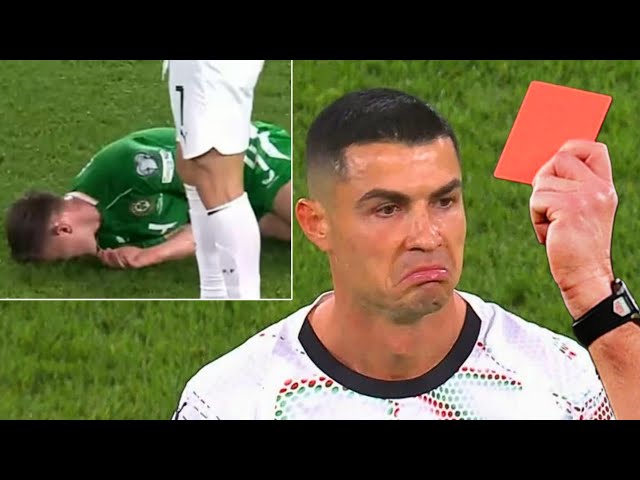
Recently, the football world has been in turmoil—not over stunning goals or high-profile transfers—but due to Ronaldo’s red card during Portugal’s loss to the Republic of Ireland in the World Cup 2026 qualifiers. The shock from his uncontrolled behavior quickly overshadowed by another startling development: FIFA’s decision to suspend Ronaldo’s ban, potentially paving his way into the World Cup.
Amid this media storm, transfer guru Fabrizio Romano reported that some potential rivals of Portugal are contemplating legal action against FIFA for perceived favoritism. However, upon closer inspection, logically and legally, it’s clear that this rumor is little more than a cheap attempt to sensationalize an already hot topic. Such a lawsuit is unlikely to ever materialize.
First, let’s dissect the absurdity behind the claims of rival teams wishing to sue. While Romano is a respected figure in transfer news, his references to British tabloids, particularly sensational ones like the Daily Mail, raise significant credibility concerns.
The absurdity lies in the timing of these allegations: the World Cup 2026 qualifiers are not yet complete, play-off matches are still pending, and crucially, the final tournament draw has not yet occurred.
So, who would be the actual “opponent” of Portugal that could file a lawsuit? In both football and law, you must demonstrate that your rights are being directly violated to initiate legal action. Currently, Portugal is not assigned to any group and there’s no knowledge of future opponents.
No football federation would waste energy, money, and reputation trying to contest a disciplinary ruling that has no immediate relevance to them. Attributing the term “rivals of Portugal” to this narrative seems purely a product of imagination to dramatize the issue and tap into the frustrations of Ronaldo’s critics.
Every player wants to face Ronaldo. In fact, the idea that teams want to exclude him is even less convincing when looking at the real benefits. The World Cup is not merely a competitive arena but a monumental commercial spectacle. For smaller to mid-tier teams that might end up in Portugal’s group, facing Cristiano Ronaldo is a once-in-a-lifetime honor.
Ronaldo’s presence guarantees worldwide attention, skyrocketing broadcasting rights’ value, and gives opposing players the chance to compete against one of the greatest legends of all time. A match without CR7 loses much of its appeal.
Thus, instead of finding ways to sideline him, rivals would actually crave for Ronaldo to be on the pitch. No one in their right mind would sue to jeopardize their own media interest, especially knowing that the next World Cup may be the superstar’s swan song.
Suing FIFA is essentially “throwing money out the window” because FIFA acted within the confines of its own regulations.
Setting aside marketing and media considerations, if a team were foolish enough to take their case to the Court of Arbitration for Sport (CAS), their chances of winning would be nearly non-existent. Legal analyses show that FIFA holds strong ground; they have skillfully applied their rules correctly and lawfully, rather than arbitrarily bending traditions as some claim.
Bringing a case against FIFA would entail exorbitant legal costs and a labyrinth of formalities. At its core, FIFA’s decisions are well-justified under their own disciplinary codes. Specifically, the FIFA Disciplinary Committee utilized the “suspended suspension” mechanism clearly outlined in the Disciplinary Code. Generally, for violent conduct, the base penalty is a three-match suspension. However, the law allows the disciplinary body to consider mitigating circumstances—like prior conduct history, the actual severity of the incident, and the player’s demeanor—to lessen part of the penalty to a suspended sentence with a probation period.
In Ronaldo’s case, FIFA had solid grounds for leniency. In his illustrious career of over 200 national team caps—a record unmatched in world football—this is the first time he received a direct red card for misconduct. His clean history over two decades at the international level is a highly compelling mitigating factor that any tribunal would recognize.
FIFA hasn’t eradicated the ban; they’ve merely adjusted its implementation. Ronaldo still faces a one-match suspension (the final qualifier), while the remaining two matches are suspended for a year. Should he re-offend, the penalties will be activated immediately.
This decision strikes a balance between deterrence and humanity in sports law towards a player of great contribution. Thus, using FIFA’s so-called “favoritism” to launch litigation is a weak argument rooted in misunderstanding the disciplinary process.
Any sports lawyer would advise their client against pursuing such a futile lawsuit. Ultimately, this uproar is merely a tempest in a teapot, and fans can rest easy as they await Ronaldo’s final strides on the grand football stage.